The Science
GLP Peptiva™ – The Science
Working with your body’s natural appetite and glucose regulation pathways.
GLP Peptiva™ offers a science-led approach to supporting appetite regulation and post-meal glucose balance. As awareness of GLP-1 continues to grow, more people are recognising the important role appetite hormones play in hunger, fullness and the body’s response to food.
The rise of GLP-1 medications has transformed the way we think about appetite, weight management and metabolic health.1 While these medications have brought incretin biology into the spotlight, they have also sparked wider interest in understanding how the body’s natural appetite regulation pathways work.
For many adults, maintaining control over hunger, cravings and energy levels can feel like a daily challenge. With 66% of adults in England now living with overweight or obesity,2 there is growing interest in understanding the biological factors that influence appetite, weight management and metabolic health.
Appetite regulation is influenced by a complex network of biological signals that help determine when we feel hungry, when we feel satisfied and how our bodies respond to food after a meal.3
At Regulate Health, we believe these natural processes shouldn’t be overridden — they should be supported.
That’s why we’ve chosen clinically studied ingredients backed by human research and designed to work alongside your body’s own biological pathways. Rather than relying on gimmicks or quick fixes, our approach focuses on supporting the hormones and metabolic processes involved in appetite regulation, glucose balance and overall metabolic wellbeing.
Nextida® GC: The Science Behind GLP Peptiva™
At the heart of GLP Peptiva™ is Nextida® GC, a patented and clinically studied collagen peptide composition specifically developed to support appetite regulation and metabolic health.
Unlike traditional collagen supplements, which are primarily associated with skin, hair or joint health, Nextida® GC has been researched for its ability to support the body’s natural response to food.
What makes Nextida® GC unique is its clinically studied ability to support the body’s natural incretin response following a meal. Incretins are natural hormones released by the gut after eating that help regulate hunger, fullness and the body’s response to food.
In a placebo-controlled human clinical trial, participants consumed Nextida® GC before a carbohydrate-rich meal. Researchers observed significant improvements across several key markers involved in appetite regulation, glucose metabolism and insulin response.4
The study demonstrated that Nextida® GC increased the secretion of both GLP-1 (Glucagon-Like Peptide-1) and GIP (Glucose-Dependent Insulinotropic Polypeptide), two important incretin hormones involved in appetite regulation, satiety and glucose metabolism.
Together, these findings suggest that Nextida® GC works alongside the body's natural biological pathways to support a healthier metabolic response to food.
Clinical Study Highlights4
25%
Increased GLP-1 secretion
60%
Increased GIP secretion
37.2 min
Slower gastric emptying
42%
Reduced post-meal glucose spikes
Improved
Insulin response
Source: Nextida® GC Human Clinical Research Study.4
Increased GLP-1 Secretion
One of the most significant findings from the clinical study was an increase in GLP-1 secretion following supplementation with Nextida® GC.
GLP-1 is a naturally occurring hormone released by the gut after eating and is one of the body’s key regulators of appetite and satiety. It helps communicate feelings of fullness to the brain and plays an important role in regulating appetite, insulin secretion and blood glucose levels.5
Compared with placebo, participants consuming Nextida® GC experienced approximately 25% greater GLP-1 secretion following a meal.
This finding is particularly important because GLP-1 sits at the beginning of a chain of physiological events involved in appetite regulation, insulin secretion and blood glucose control.
What this may mean in real life
Many people struggle with persistent hunger, cravings or feeling unsatisfied after meals. By supporting the body’s natural GLP-1 response, Nextida® GC may help strengthen the biological signals involved in fullness and appetite regulation.5
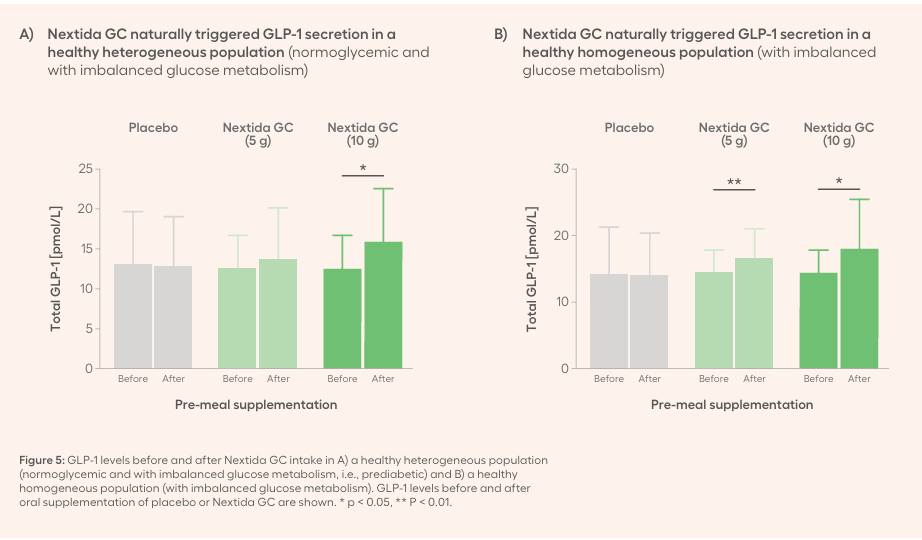
| Placebo | Nextida GC (5 g) | Nextida GC (10 g) | |
|---|---|---|---|
| A) Heterogeneous population — Before | 13 | 12.5 | 12.5 |
| A) Heterogeneous population — After | 12.5 | 13.5 | 15.5 |
| B) Homogeneous population — Before | 14 | 14.5 | 14.5 |
| B) Homogeneous population — After | 14 | 16.5 | 18 |
Figure 5: GLP-1 levels before and after Nextida GC intake in A) a healthy heterogeneous population (normoglycemic and with imbalanced glucose metabolism, i.e., prediabetic) and B) a healthy homogeneous population (with imbalanced glucose metabolism). * p < 0.05, ** p < 0.01.
Slower Gastric Emptying
Gastric emptying refers to the rate at which food leaves the stomach and moves into the small intestine.
This process plays an important role in appetite regulation and blood glucose control. When food leaves the stomach more gradually, nutrients are delivered to the intestine at a slower rate, helping the body respond more steadily following a meal.
In the clinical study, participants consuming 10 g of Nextida® GC experienced gastric emptying that was approximately 37.2 minutes slower than those receiving placebo.
Slower gastric emptying is one of the ways the body naturally helps regulate appetite and post-meal glucose responses. It is also one of the physiological actions associated with GLP-1 following food intake.5
What this may mean in real life
While individual responses will vary, slower gastric emptying may help support:
- Feeling fuller for longer after meals.
- Improved satisfaction following eating.
- A steadier release of nutrients into the bloodstream.
- A more gradual post-meal glucose response.
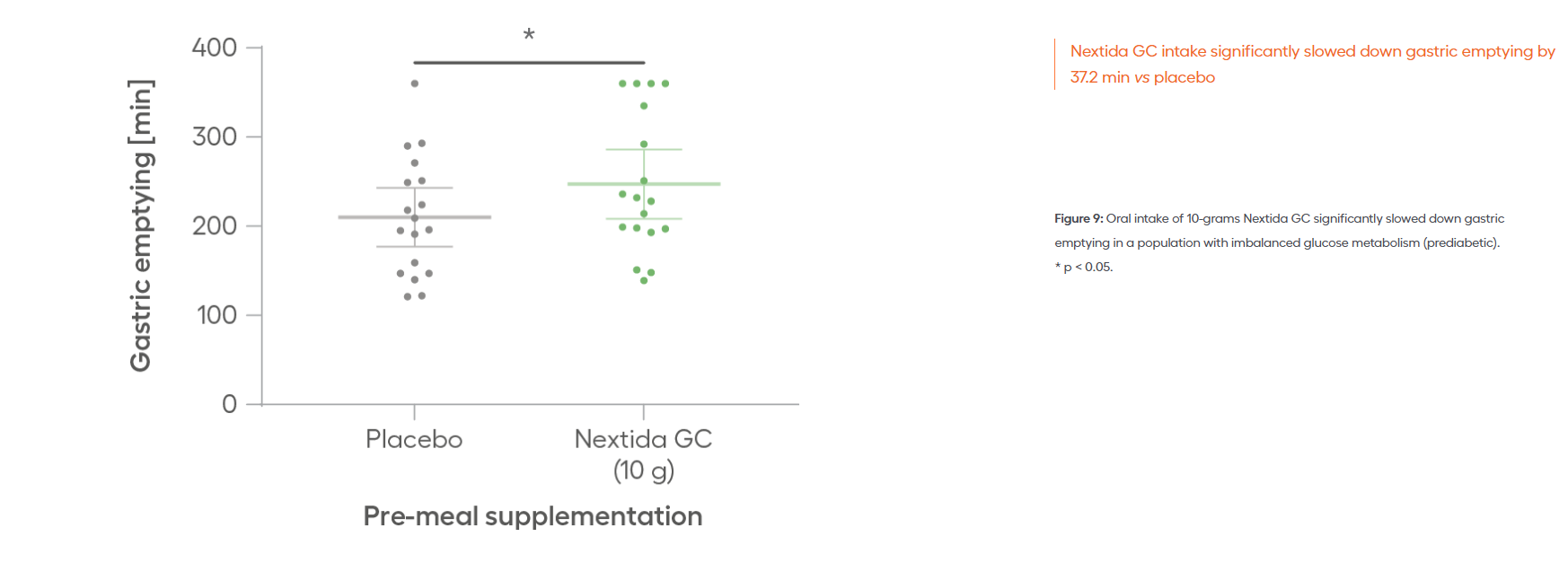
| Placebo | Nextida GC (10 g) | |
|---|---|---|
| Gastric emptying [min] | 210 | 247.2 |
Pre-meal supplementation. Source: Nextida® GC Human Clinical Research Study.
Increased GIP Secretion
While GLP-1 often receives most of the attention, it is only part of the story.
The clinical study also demonstrated an increase in GIP, another important incretin hormone released following a meal.
Working alongside GLP-1, GIP helps coordinate the body’s metabolic response to food and plays an important role in healthy glucose and insulin regulation.6
Compared with placebo, participants consuming Nextida® GC experienced approximately 60% greater GIP secretion.
What this may mean in real life
The fact that Nextida® GC supports both GLP-1 and GIP suggests that it works across multiple interconnected pathways involved in appetite regulation, glucose metabolism and insulin function, rather than targeting a single mechanism alone.6
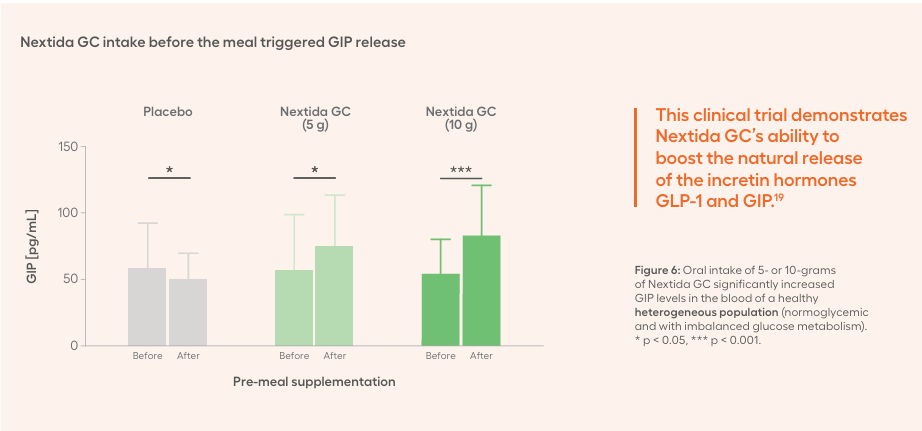
| Placebo | Nextida GC (5 g) | Nextida GC (10 g) | |
|---|---|---|---|
| Before | 60 | 58 | 55 |
| After | 50 | 78 | 82 |
Figure 6: Oral intake of 5- or 10-grams of Nextida GC significantly increased GIP levels in the blood of a healthy heterogeneous population (normoglycemic and with imbalanced glucose metabolism). * p < 0.05, *** p < 0.001.
Reduced Post-Meal Glucose Spikes
Every time we eat carbohydrates, our blood glucose levels naturally rise. This is a normal and healthy physiological response to food.7
However, for some people, these rises can be larger and more rapid than ideal, resulting in what is commonly referred to as a “post-meal glucose spike” — a rapid rise in blood glucose following a meal.
According to Diabetes UK, more than 12 million people in the UK are currently living with either diabetes or prediabetes,8 highlighting growing concerns around glucose regulation and metabolic health.
Large fluctuations in blood glucose are often followed by a rapid decline, sometimes referred to as a “glucose crash”. Research suggests these dips may be associated with increased hunger and a greater likelihood of eating sooner after a meal.9
In the clinical study, participants consuming Nextida® GC experienced approximately 42% lower post-meal glucose spikes compared with placebo.
What this may mean in real life
A healthier post-meal glucose response may help support:
- More stable energy levels throughout the day.
- Reduced energy dips following meals.
- Healthy appetite regulation.
- A more balanced response to food.
Potential benefits are based on observed relationships between glucose regulation, appetite and subsequent food intake.9
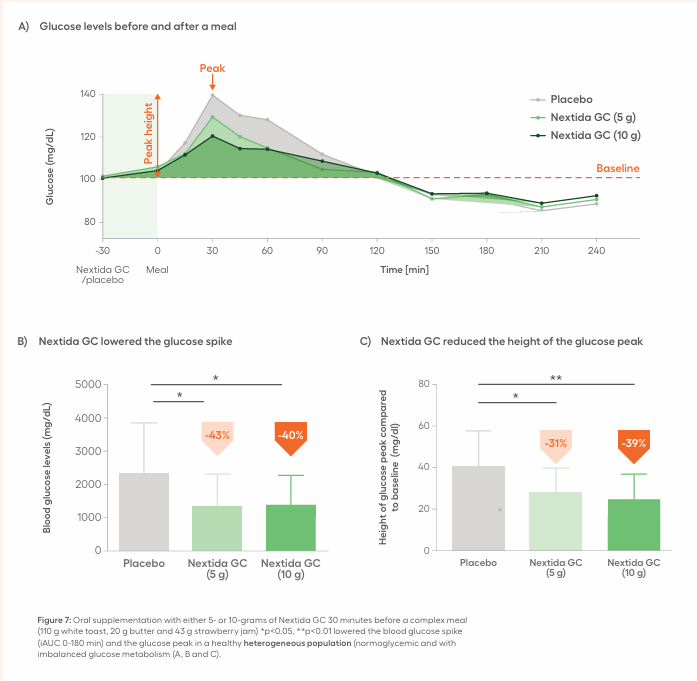
| Time [min] | Placebo | Nextida GC (5 g) | Nextida GC (10 g) |
|---|---|---|---|
| -30 | 100 | 100 | 100 |
| 0 | 105 | 105 | 105 |
| 30 | 140 | 130 | 120 |
| 60 | 125 | 115 | 110 |
| 90 | 115 | 110 | 105 |
| 120 | 105 | 105 | 105 |
| 150 | 95 | 95 | 95 |
| 180 | 95 | 95 | 95 |
| 210 | 90 | 85 | 85 |
| 240 | 95 | 90 | 90 |
| Group | iAUC (mg/dL) | Group | Height (mg/dL) |
|---|---|---|---|
| Placebo | 2400 | Placebo | 40 |
| Nextida GC (5 g) | 1400 | Nextida GC (5 g) | 28 |
| Nextida GC (10 g) | 1450 | Nextida GC (10 g) | 25 |
Figure 7: Oral supplementation with either 5- or 10-grams of Nextida GC 30 minutes before a complex meal lowered the blood glucose spike (iAUC 0-180 min) and the glucose peak in a healthy heterogeneous population. * p < 0.05, ** p < 0.01.
Supporting a Healthy Insulin Response
Insulin is a hormone produced by the pancreas that helps move glucose from the bloodstream into cells, where it can be used for energy.
Following a meal, GLP-1 and GIP work together to help coordinate the body’s insulin response, ensuring glucose is managed efficiently.
Researchers observed improvements in insulin response following supplementation with Nextida® GC.4
Interestingly, the research suggests that by supporting the release of GLP-1 and GIP before blood glucose levels begin to rise significantly, the body may be better prepared to manage incoming nutrients following a meal.
What this may mean in real life
Together with the observed increases in GLP-1 and GIP and the reduction in post-meal glucose spikes, these findings suggest that Nextida® GC supports a more balanced physiological response to food.
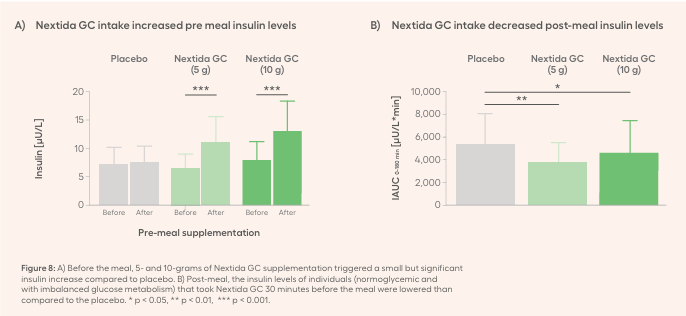
| A) Pre-meal insulin levels | |||
|---|---|---|---|
| Placebo | Nextida GC (5 g) | Nextida GC (10 g) | |
| Before | 7 | 6.5 | 8 |
| After | 7 | 11 | 13 |
| B) Post-meal insulin exposure | |||
|---|---|---|---|
| Placebo | Nextida GC (5 g) | Nextida GC (10 g) | |
| iAUC 0-180 min [µU/L*min] | 5,500 | 3,800 | 4,500 |
Figure 8: A) Before the meal, 5- and 10-grams of Nextida GC supplementation triggered a small but significant insulin increase compared to placebo. B) Post-meal, insulin levels were lower than compared to the placebo. * p < 0.05, ** p < 0.01, *** p < 0.001.
Why These Findings Matter
The clinical research on Nextida® GC demonstrates more than a single outcome. It reveals a connected sequence of physiological responses that help explain how the ingredient supports appetite regulation and glucose balance.
↑
GLP-1
↑
GIP
↓
Glucose spikes
↑
Insulin response
Slower Gastric Emptying
Together with the hormonal changes above, slower gastric emptying helps support a healthier response to food.
Together, these findings suggest that Nextida® GC works alongside the body’s natural biological pathways to support a healthier response to food. This integrated response is what makes Nextida® GC unique and forms the foundation of GLP Peptiva™.
Why Chromium?
Alongside Nextida® GC, GLP Peptiva™ contains chromium, an essential trace mineral that contributes to the maintenance of normal blood glucose levels and normal macronutrient metabolism.11
While Nextida® GC supports the body's natural incretin response, chromium provides complementary nutritional support for healthy glucose metabolism and insulin function.10
Together, these two ingredients provide targeted support for the body's natural appetite and glucose regulation pathways.
Chromium contributes to:
- The maintenance of normal blood glucose levels*
- Normal macronutrient metabolism*
*Approved UK and EU nutrition and health claims.11
Trusted Science. Trusted Ingredients
GLP Peptiva™ contains just two active ingredients — because we believe effective formulations aren’t about including more ingredients, they’re about choosing the right ones.
At Regulate Health, we believe ingredients should earn their place in our products. Nextida® GC was selected because of its clinically studied ability to support the body’s natural incretin response, appetite regulation and post-meal glucose balance.
Alongside Nextida® GC, we included chromium to provide complementary nutritional support for healthy glucose metabolism. Together, these ingredients provide targeted support for the body’s natural appetite and glucose regulation pathways.
What Could This Mean For You?
The science behind GLP Peptiva™ is centred around supporting the body’s natural response to food. While individual experiences may vary, the clinical findings behind Nextida® GC suggest potential benefits such as:
- Supporting healthy appetite regulation
- Helping you feel satisfied after meals
- Supporting balanced post-meal glucose responses
- Supporting feelings of fullness by slowing the body's natural gastric emptying process
- Helping maintain stable energy levels throughout the day
- Supporting a healthier metabolic response to food
- Supporting long-term metabolic wellbeing
GLP Peptiva™ is not designed to replace healthy habits. Instead, it has been formulated to work alongside a balanced diet and healthy lifestyle, supporting the body’s natural biological processes through clinically studied ingredients. Because lasting change doesn’t come from fighting your biology — it comes from working with it.
References
- Müller, T.D., Finan, B., Bloom, S.R., D'Alessio, D., Drucker, D.J., Flatt, P.R., Fritsche, A., Gribble, F., Grill, H.J., Habener, J.F., Holst, J.J., Langhans, W., Meier, J.J., Nauck, M.A., Perez-Tilve, D., Pocai, A., Reimann, F., Sandoval, D.A., Schwartz, T.W., Seeley, R.J., Stemmer, K., Tang-Christensen, M., Woods, S.C., DiMarchi, R.D. and Tschöp, M.H. (2019) 'Glucagon-like peptide 1 (GLP-1)', Molecular Metabolism, 30, pp. 72–130.
- NHS Digital (2023) Health Survey for England 2021: Adult overweight and obesity. Leeds: NHS Digital.
- Blundell, J.E. and Finlayson, G. (2015) 'Appetite control and energy balance: impact of exercise', Current Opinion in Behavioral Sciences, 4, pp. 135–142.
- Rousselot (2024) Nextida® GC Human Clinical Research Study. Internal clinical study report.
- Holst, J.J. (2007) 'The Physiology of Glucagon-Like Peptide-1', Physiological Reviews, 87(4), pp. 1409–1439.
- Nauck, M.A. and Meier, J.J. (2018) 'Incretin hormones: Their role in health and disease', Diabetes, Obesity and Metabolism, 20(Suppl. 1), pp. 5–21.
- American Diabetes Association Professional Practice Committee (2024) 'Standards of Care in Diabetes—2024', Diabetes Care, 47(Suppl. 1).
- Diabetes UK (2024) Diabetes and Prediabetes Statistics. Available at: https://www.diabetes.org.uk (Accessed: 25 June 2026).
- Wyatt, P., Berry, S.E., Finlayson, G., O'Driscoll, R., Hadjigeorgiou, G., Drew, D.A., et al. (2021) 'Postprandial glycaemic dips predict appetite and energy intake in healthy individuals', Nature Metabolism, 3, pp. 523–529.
- EFSA Panel on Dietetic Products, Nutrition and Allergies (NDA) (2010) 'Scientific Opinion on the substantiation of health claims related to chromium', EFSA Journal, 8(10).
- European Commission (2024) EU Register of Nutrition and Health Claims Made on Foods. Available at: https://food.ec.europa.eu/safety/labelling-and-nutrition/nutrition-and-health-claims_en (Accessed: 25 June 2026).